The Business Opportunity Brief
Take advantage of your season: five industries, five plays — and the sale to advertise before each one hits
Here’s a secret most owners learn the hard way: every industry has its own season. Start with the one everyone knows — a gym’s year turns in January, when the resolution crowd walks in. The owners who win their season aren’t the ones who work the hardest during the rush; they’re the ones who saw it coming and quietly got ready — the sale advertised, the people hired, the capital lined up before any of it was needed. That’s why we put this brief together: a funder hands you capital, but a smart partner hands you the heads-up first. Here are five industries whose seasons are written on the calendar — gyms and fitness, tax and accounting, HVAC, landscaping and lawn care, and wedding venues and photographers — the season each one lives for, the play to run, and the sale to advertise before the spike arrives. If the banks said no and the brokers wasted your time — your search ends here.
Business-purpose funding. Subject to underwriting, verification, and program availability.
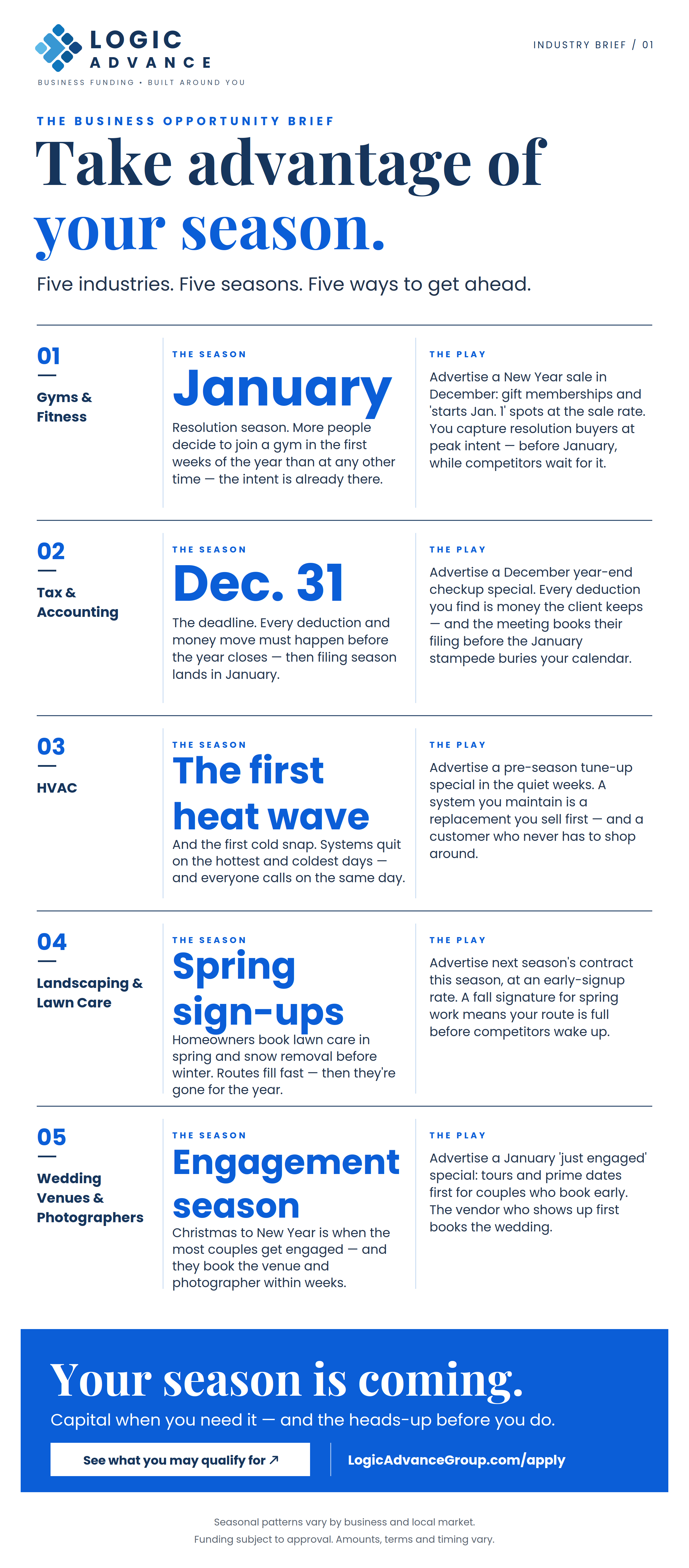
The five seasons at a glance
Every play below comes straight from the brief — the season, the play, and the sale to advertise for five industries whose biggest weeks are set by the calendar months in advance. Start with the one for your industry, and notice when your season really begins — every trade’s peak lands at a different time of year — then borrow the moves that fit from the other four.
| Industry | Its season | The play |
|---|---|---|
| Gyms & Fitness | January — Resolution season. | Advertise a New Year sale in December — gift memberships and ‘starts Jan. 1’ spots at the sale rate. |
| Tax & Accounting | Dec. 31 — The deadline. | Advertise a December year-end checkup special that books January filings early. |
| HVAC | The first heat wave — And the first cold snap. | Advertise a pre-season tune-up special in the quiet weeks before systems start quitting. |
| Landscaping & Lawn Care | Spring sign-ups — Routes fill fast. | Advertise next season’s contract this season, at an early-signup rate. |
| Wedding Venues & Photographers | Engagement season — Christmas to New Year. | Advertise a January ‘just engaged’ special — tours and prime dates first for early bookers. |
None of these plays work on good intentions alone — the sale has to be advertised, staffed and stocked before the spike, and all of that spends money before it makes money. That timing gap is the whole reason working capital exists. Our seasonal business funding plan walks through the timing — and taking advantage of your season means arranging the capital before your season arrives, not in the middle of it.
“Every industry has its own peak.”
01 · Gyms & Fitness
The season: January — Resolution season. More people decide to join a gym in the first weeks of the year than at any other time — the intent is already there.
The play: Advertise a New Year sale in December: gift memberships and ‘starts Jan. 1’ spots at the sale rate. You capture resolution buyers at peak intent — before January, while competitors wait for it.
Start with the one everyone knows. Every gym owner can feel the calendar: December is quiet, and the first two weeks of January can sign up more members than the previous two months put together. But January’s members made their decision in December — scrolling at midnight, comparing gyms, promising themselves this is the year. The gyms that get them are the ones in front of them at that moment, with a sale worth acting on and a start date that matches the motivation. Motivation has an expiration date. The play is to be selling while it is fresh.
Four ways to run this play
Trainers, front-desk help and a December ad push all cost money before the first January sign-up lands. Fitness center funding can put that capital in place ahead of resolution season — or go straight to the short application and see what you may qualify for.
02 · Tax & Accounting
The season: Dec. 31 — The deadline. Every deduction and money move must happen before the year closes — then filing season lands in January.
The play: Advertise a December year-end checkup special. Every deduction you find is money the client keeps — and the meeting books their filing before the January stampede buries your calendar.
For tax pros, the year has a hard edge: December 31. Every deduction, contribution and income decision a client makes either happens before that date or waits a full year — and clients who miss a move remember the advisor they never heard from. December is also when sharp firms quietly fill their January calendars, while competitors wait for the phone to ring in the new year and take whoever walks in.
Four ways to run this play
A December mailer, extra hands for January and software seats all get paid for before filing fees arrive. See funding options by industry for professional firms — or check what you may qualify for before the deadline does your planning for you.
03 · HVAC
The season: The first heat wave — And the first cold snap. Systems quit on the hottest and coldest days — and everyone calls on the same day.
The play: Advertise a pre-season tune-up special in the quiet weeks. A system you maintain is a replacement you sell first — and a customer who never has to shop around.
HVAC demand does not spread out — it detonates. The first brutal hot day and the first hard freeze produce more calls in 48 hours than a quiet month, and every caller wants the company that already knows their system. The calm weeks in between are when that loyalty gets bought — cheaply, with a tune-up special — instead of expensively, with emergency ads fired off in the middle of the spike.
Four ways to run this play
A spring mailer, parts on the shelf and one more tech on the truck all get paid for before the first emergency call comes in. HVAC contractor financing is built for exactly that gap — or see what you may qualify for while the weeks are still quiet.
04 · Landscaping & Lawn Care
The season: Spring sign-ups — Homeowners book lawn care in spring and snow removal before winter. Routes fill fast — then they’re gone for the year.
The play: Advertise next season’s contract this season, at an early-signup rate. A fall signature for spring work means your route is full before competitors wake up.
Landscaping runs on signatures, not walk-ins. Homeowners pick their lawn company in a few spring weeks and their snow removal before the first storm — and then the routes are set for the year. The companies rolling into spring with full routes signed those clients in the fall and the quiet winter weeks, in the months when everyone else had stopped advertising entirely.
Four ways to run this play
Equipment, trucks and crews all get lined up in the quiet months, before the first spring invoice goes out. Landscaping business funding can bridge those months — or check what you may qualify for before spring sign-ups open.
05 · Wedding Venues & Photographers
The season: Engagement season — Christmas to New Year is when the most couples get engaged — and they book the venue and photographer within weeks.
The play: Advertise a January ‘just engaged’ special: tours and prime dates first for couples who book early. The vendor who shows up first books the wedding.
The wedding business is won in a window most vendors sleep through. More couples get engaged between Christmas and New Year than at any other stretch — and they start booking the venue and the photographer within weeks, sometimes days. By the time the spring wedding shows open, next year’s best dates are already gone — taken by the vendors who showed up in January, when the ring was new and the excitement was at its peak.
Four ways to run this play
January advertising, show booths and help answering inquiries all cost money in your slowest booking month — right before your biggest one. See funding options by industry — or go straight to the short application and be ready when the proposals land.
Questions business owners ask
What is a seasonal play?
A seasonal play is a sale built around the moment your industry’s demand spikes. Every trade has one — gyms in January, tax pros at the Dec. 31 deadline, HVAC at the first heat wave, landscapers at spring sign-ups, wedding vendors in engagement season. This brief matches five industries with their seasons, the play to run in each, and the sale to advertise before the spike arrives — so you capture buyers at peak intent instead of chasing them after it.
Why advertise the sale before the season starts?
Because that is when the decision gets made. Members who start at a gym in January chose it in December; couples booking venues in January got engaged in December; homeowners sign lawn contracts weeks before the first mow. Advertise during the spike and you compete with everyone, at the highest ad prices. Advertise before it and you are the name they already trust when the moment hits.
When should I line up capital ahead of my season?
Weeks before the spike — while you still have options. The play itself costs money first: ad spend, inventory, seasonal staff, equipment. All of it is paid before the season’s revenue arrives, and that timing gap is exactly what working capital is built to bridge. Knowing what you qualify for ahead of time lets you advertise the sale with confidence instead of hoping the cash stretches.
My industry is not one of the five — can I still use this?
Yes. The five are examples of a pattern that repeats in every trade: a deadline, a change of season, a life event — some moment when your customers’ need peaks. Find your moment, name the sale you will run for it, and put that sale in front of the customers you already have before the moment arrives. The industries change; the calendar logic does not.
How fast can a business get funding ahead of a busy season?
The application is short, and decisions can come in as little as 4 hours, with funding as fast as same day for approved businesses. Timing depends on the program, the amount and verification — one more reason to apply before your season starts rather than in the middle of it. Funding is subject to approval, and amounts, terms and timing vary.
Can I share or republish the brief graphic?
Yes — the brief was made to be shared. You are welcome to pass the graphic along or use it in your own content with credit to Logic Advance and a link back to this page, so your readers can find the full per-industry plays. Sharing it as-is keeps the plays and the reasoning intact for everyone who sees it.
Your season is coming. Be ready for it.
Picture it: the sale already advertising when your season opens, a team you can count on, your busiest weeks booked instead of hoped for. That is what taking advantage of your season looks like — and it starts with knowing what you qualify for before you need it. One short application, a decision in as little as 4 hours, and funding as fast as same day for approved businesses. No obligation — just a clear answer while there is still time to act on it. That is the difference a smart partner makes — capital when you need it, and the heads-up before you do.
Business-purpose funding. Subject to underwriting, verification, and program availability.
Seasonal patterns vary by business and local market. Funding subject to approval. Amounts, terms and timing vary. This page explains planning considerations and starting guidelines, not a funding offer.